Paddling after midnight. It's 12:47 am, and we're aiming for Little Salmon Village for the night. But, because I was cold and grumpy, we stopped at about 2:00 am at Twin Creeks (75 km south of Carmacks). The third of the three campsites is the nicest of the group.
Getting tired
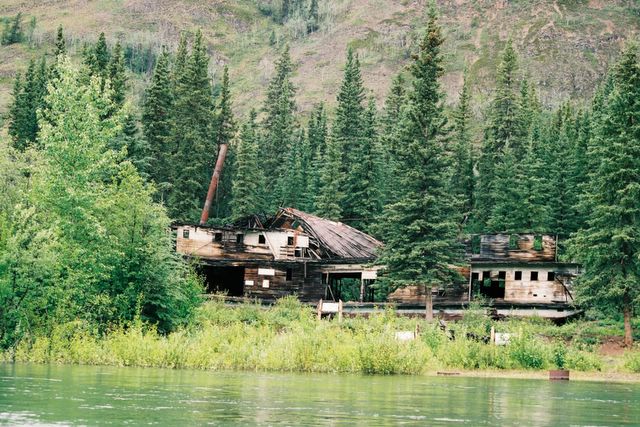
Cyr's Dredge. High water levels obscured a number of gold rush artifacts
Hootalinqua campsites. At its peak in 1898, the Klondike gold rush saw nearly 30,000 gold seekers in 7,000 boats travel the Thirty Mile en route from Bennett, B.C. to the goldfields near Dawson City. Although Hootalinqua already existed as a stopping place for Teslin River miners, both it and Lower Laberge took on great importance during and after the gold-rush due to its important position at the junction of the main stampede route to the Klondike and the secondary "All-Canadian Route" which went up the Stikine River then overland to Teslin Lake, the NWMP built a post here in 1898. Although the permanent population was never more than about a dozen, a telegraph station was built in 1900, and Taylor & Drury had a store in 1901-1902. At Lower Laberge, there was a telegraph station, a North West Mounted Police post, supply depots, and later a roadhouse for travellers. At Hootalinqua too there was a telegraph station and police post, and later, on nearby Shipyard Island, slipways and a winter storage yard for paddlewheelers. Located between the two was 17–Mile Wood Camp, one of many along the river which supplied the insatiable boilers of the paddlewheelers.