Tuesday, November 18, 2008

Global Warming? What Evidence Do You Have?


Sent to you by nwallis via Google Reader:


via The Big Picture by Barry Ritholtz on 11/17/08

I'm no expert, but a century worth of data shows the change in global temperatures:

>

Global Annual Mean Surface Air Temperature Change


Source: NASA

~~~

Global Air Temperature
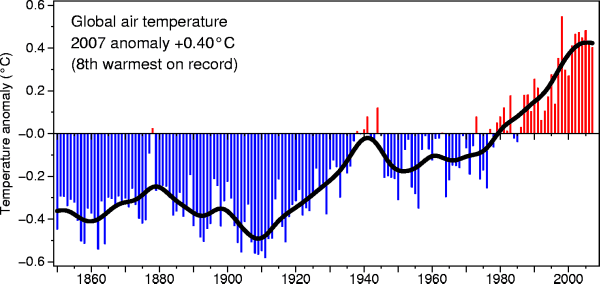
Source: Climatic Research Unit : Information sheets

~~~

Global Temperatures of the Last Five Centuries
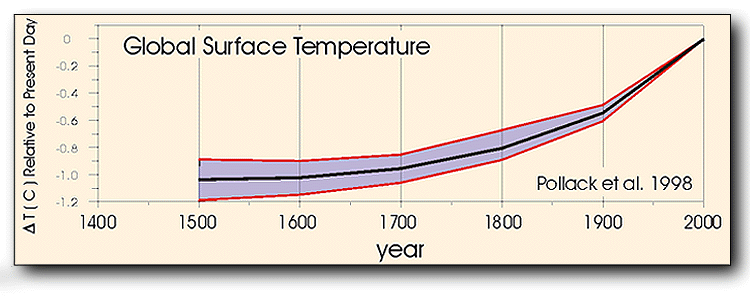
Source: NOAA Paleoclimatology Program

~~~

Global Glacier Thickness Change
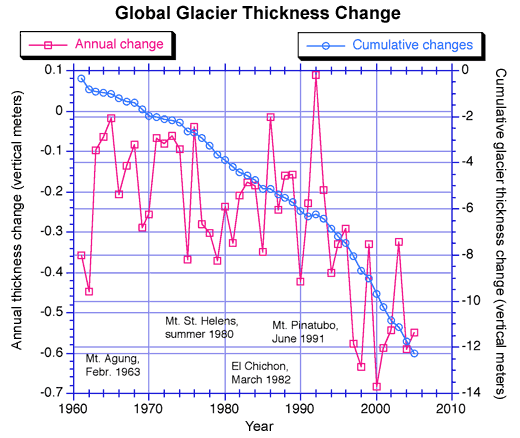
Source: The National Snow and Ice Data Center, Cryospheric Research Since 1976 University of Colorado

~~~

Sea Ice Decline Intensifies
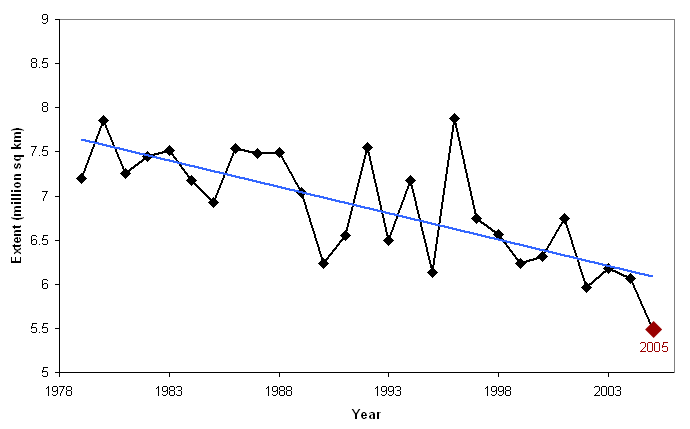
Source: The National Snow and Ice Data Center, Cryospheric Research Since 1976 University of Colorado

~~~

Sea Level Change
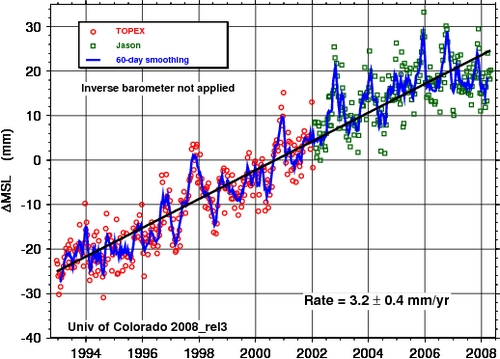
Source: University of Colorado at Boulder

~~~

Proxy Temperature Studies
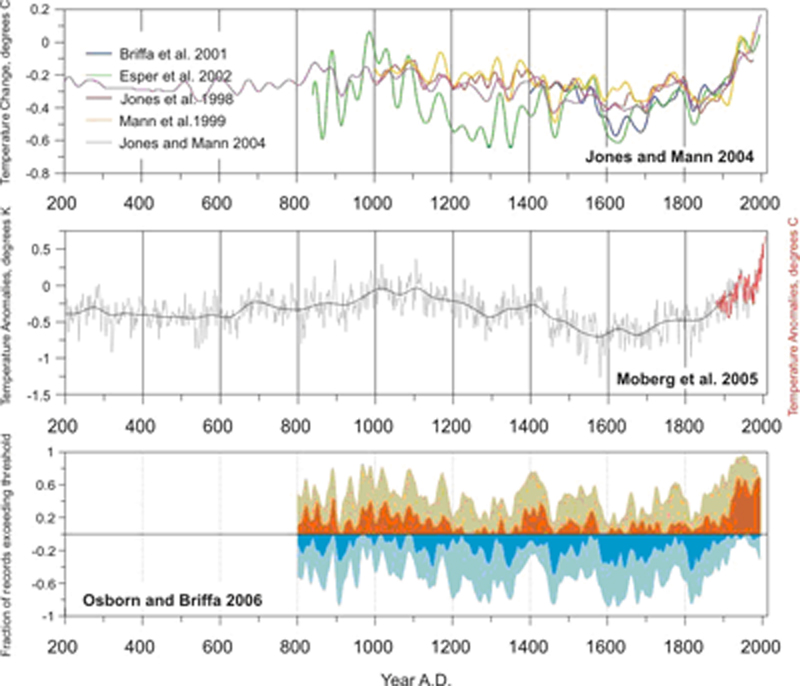
Source: NOAA


Things you can do from here:


Monday, November 17, 2008

"This should end well" dept.

Can we start a dead pool please?


Sent to you by nigel via Google Reader:


via Daimnation! by damian on 11/17/08

A German university professor - and convert to Islam - says Mohammed may never have existed. And he doesn't appear to be suicidal:

Muhammad Sven Kalisch, a Muslim convert and Germany's first professor of Islamic theology, fasts during the Muslim holy month, doesn't like to shake hands with Muslim women and has spent years studying Islamic scripture. Islam, he says, guides his life.

So it came as something of a surprise when Prof. Kalisch announced the fruit of his theological research. His conclusion: The Prophet Muhammad probably never existed.

Muslims, not surprisingly, are outraged. Even Danish cartoonists who triggered global protests a couple of years ago didn't portray the Prophet as fictional. German police, worried about a violent backlash, told the professor to move his religious-studies center to more-secure premises.

"We had no idea he would have ideas like this," says Thomas Bauer, a fellow academic at Münster University who sat on a committee that appointed Prof. Kalisch. "I'm a more orthodox Muslim than he is, and I'm not a Muslim."

[...]

Prof. Kalisch, who insists he's still a Muslim, says he knew he would get in trouble but wanted to subject Islam to the same scrutiny as Christianity and Judaism. German scholars of the 19th century, he notes, were among the first to raise questions about the historical accuracy of the Bible.(via The Volokh Conspiracy)

Many scholars openly question the existence of Jesus Christ and the veracity of the Old Testament, and Kalisch should have every right to promote his provocative theory about Mohammed. (To their credit, many European academics - including several Muslims - have risen to his defence.)

That said, questioning the existence of Mohammed - not whether he was a prophet, but whether he existed at all - seems more like questioning whether L. Ron Hubbard really existed:

Many scholars of Islam question the accuracy of ancient sources on Muhammad's life. The earliest biography, of which no copies survive, dated from roughly a century after the generally accepted year of his death, 632, and is known only by references to it in much later texts. But only a few scholars have doubted Muhammad's existence. Most say his life is better documented than that of Jesus.

Damian P.


Things you can do from here:


Model this in the forecast...


Sent to you by nigel via Google Reader:


via Daimnation! by markc on 11/17/08

The bigger industry picture is being noticed at last:

The failure of one or more of Detroit's Big Three automakers would put a huge initial dent in American manufacturing, but in time foreign car companies would pick up the slack by stepping up production in their plants here, many industry experts and economists say.

Whether Washington should let that play out — risking hundreds of thousands of jobs — is a central question Congress will weigh this week as it hears testimony from Detroit leaders who are pushing for immediate federal intervention, before the next administration takes over in January.

"Barack Obama has made it clear he understands the importance of the industry. The question is, do we get that far?" Ron Gettelfinger, head of the United Auto Workers, said in an interview Friday, raising the prospect of a General Motors bankruptcy. "At this juncture, we are in a crisis that could have a major negative impact on this country."

But many industry experts say the big foreign makers are established enough to take control of the industry and its vast supplier network more quickly than is widely understood.

"You would have an auto industry in the United States more like that of Mexico and Canada: foreign-owned," said Sean McAlinden, chief economist at the Center for Automotive Research in Ann Arbor, Mich., which describes itself as a nonprofit organization that has "strong relationships with industry, government agencies, universities, research institutes, labor organizations" and other groups with an interest in the auto business...

This is related:

Why Bankruptcy Is the Best Option for GM

Meanwhile, there's a canary sniffing around the Pentastar:

EDC's Chrysler action signals growing fears

Agency declines to take new requests from parts makers to insure receivables

And a canary chez le General:

GM to sell stake in Suzuki to raise cash

Mark C.


Things you can do from here:


The Obama administration: Here's your briefing book. Better pack a lunch

For Emile and Joel.

If you wanted a heads up on the short, medium and long term direction of the Obama gov't, it's hiding in plain sight.


Sent to you by nigel via Google Reader:


via inkless-wells « WordPress.com Tag Feed by Paul Wells on 11/17/08

So here's the thing. I interviewed Jim Prentice today for a piece a few of us are working on, about the shape relations between the Harper government and its looming Obama counterpart might take. The environment minister named three people who have been leading on climate-change policy for the Democrats. I nodded sagely, then ran back to the office and googled their names. All three are affiliated with the Center for American Progress, a centre-left Washington think tank.

But it's rather more than that, actually. Under John Podesta, Bill Clinton's last chief of staff, the Center for American Progress has been described by one of Washington's finer reporters as a Democratic government-in-waiting. And here's how it can be useful to you, the incredibly wonky Inkless reader.

Last Wednesday the Center for American Progress released a book purporting to be a proposed policy agenda for the Obama administration. The damned thing has 57 chapters. Ten are available free online. And there is streaming video from five sessions at the day-long conference they had to launch the thing, cut up by files including foreign policy, energy and the environment, and the economy.

A think tank isn't a government, but when it comes to Podesta's group, the lines are intentionally blurrier than they usually are. Podesta is one of three people running Obama's transition, after all. I leave this trove of insider counsel to you, to dip into or devour according to your preference.


Things you can do from here:


Parliamentary Budget Officer: The sequel, baby


Sent to you by nigel via Google Reader:


via inkless-wells « WordPress.com Tag Feed by Paul Wells on 11/17/08

From the Inkless emailbox:

From: Page, Kevin
Sent: November 17, 2008 4:36 PM
To: - SEN SENATORS' OFF/BUR. SENATEURS; MEMBERS' OFFICES/BUREAUX DES DÉPUTÉS
Cc: - BLOC: CENTRE DE RECHERCHE ET DOCUMENTATION; - CONSERVATIVE RESEARCH/RECHERCHE CONSERVATRICE; - LIBERAL RESEARCH BUREAU; NDP Research; Nyhuus, Ken; Gallagher, Bob; Boyer, Sylvain

Subject: PBO Economic and Fiscal Assessment / Évaluation économique et fiscale du DPB

Le français suit

As the Parliamentary Budget Officer (PBO) one of my key responsibilities is to inform you of developments in the nation's finances and trends in the national economy. In meeting the commitments of my mandate, I intend to provide to you with timely assessments of the Canadian economy and federal finances.

I would like to invite you or your designate to a closed meeting to present and discuss my first report.

Date and Time: Thursday November 20 at 9:00 am
Location: Room ___, Centre Block

It is my hope that this report will provide you with helpful information and analysis as you begin to prepare for upcoming budgetary deliberations.

My economic and fiscal assessment will be followed by a technical briefing session open to the media, where my staff will be available to answer technical questions concerning the report.

I am also attaching a short briefing note that explains the process the federal government uses to prepare its economic and fiscal forecasts. This document is also available on our Web site at www.parl.gc.ca/pbo-dpb.
Sincerely,

Kevin Page
Parliamentary Budget Officer

I have inquired, and am given to understand that Mr. Page has neither sought nor received clearance from Parliamentary Librarian William Young for this latest sortie. Mr. Young won't be thrilled. In other words: It's on.


Things you can do from here:


California is burning

Some pictures of California wildfires from the Big Picture

Sunday, November 16, 2008

Global Real Estate Ratios

Nooooooooooo!!!!


Sent to you by nwallis via Google Reader:


via The Big Picture by Barry Ritholtz on 11/15/08

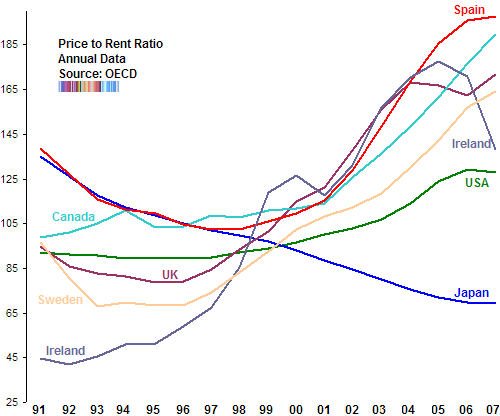
Trader's Narrative has two excellent charts showing just how overpriced real estate remains on a global basis:

Median Home Price to Median Income Ratio

Purchase Price to Rent Ratio

Source:
Global Real Estate Ratios Show Extent Of Bubble
Trader's Narrative November 13th, 2008
http://www.tradersnarrative.com/global-real-estate-ratios-show-extent-of-bubble-2066.html


Things you can do from here:


MOvember


Sent to you by nigel via Google Reader:


via furmy.com by Jesse on 11/15/08

First, my bad.
I forgot about MOvember.  It wasn't until a friend hit me up for a donation that I remembered.

So I get a late start - Nov 13th.  No MO wastin'

Why?  To raise awareness (and money) for mens' health issues and encourage my friends and family to be proactive in getting, and staying, healthy.  The funds raised go to research and fight prostate cancer in Canada.

And also because it's loads of fun to grow a moustache (ask my Dad!)

Go here to make a donation to my MOvember campaign.
Online payment via credit card or PayPal, or mail a cheque in.


Things you can do from here:


Tuesday, November 11, 2008

"But what are we remembering?"


Sent to you by nigel via Google Reader:


via Daimnation! by markc on 11/11/08

A thoughtful post, though one may have disagreements, by Dan Gardner of the Ottawa Citizen:

Ten years ago today, I was in Mons, Belgium. It was the 80th anniversary of the end of the First World War and there was a small ceremony in that beatiful medieval town to commemorate the Canadians who arrived in Mons the morning the Armistice.

There was bitter irony in the Canadian position at 11 AM, on the 11th day of November, 1918. It was in Mons in 1914 that forward units of the British army first clashed with the Germans. At one non-descript spot in the outskirts, there are plaques on either side of a little road: One commemorates the place where the first British shot was fired and the other commemorates the position held by the furthest unit forward -- a Canadian unit -- at the moment the Armistice took effect [the last Canadian fatality was at Mons in 1918, two minutes before the eleventh hour - MC]. It takes just a few steps to travel from one to the other but between the two lies four years of hell and millions of dead.

I was particularly lucky to be in Europe on the 80th anniversary because it was the last in which veterans took part in the ceremonies. I will never forget speaking to Tom Spear in a concert hall in Arras. If you know your First World War history, you know what Arras means to Canadian veterans and Spear [more here and here - MC] -- a remarkably sharp 102-years-old at the time -- fought in that war for more than three years.

Unfortunately, not many of us do know the history of the First World War because, for all the fine words about remembrance that will be spoken today, we don't remember. History continues to be treated as a fringe subject by provincial education ministries and, as the Dominion Institute surveys show [my link - MC]], historical awareness is declining, not rising.

What is on the increase is piety about remembrance. The ceremonies each November 11 attract more people, the newspapers swell with purple prose, the promises to "never forget" are intoned by suitably solemn politicians.

And then the government does something like this [Mr Gardner's link] and hardly a word of protest is heard. How do we expect historical awareness to improve when governments won't increase the time devoted to the teaching of history and won't spend what amounts to chump change to build a National Portrait Gallery and other national institutions? Ceremonies won't do it. Pious speeches won't help. Remembrance requires meaningful policies and that is the one thing governments will not deliver, and Canadians will not demand, on this day or any other.

It seems it is not remembrance we admire and seek. It is the idea of historical awareness. It is the sentiment of remembrance.

That sentiment may be very satisfying for us but remembrance is not supposed to be about us. It is about Tom Spear and the millions of others who are now gone. Ignorant sentimentalism is hollow, false, a lie.

It is a betrayal of a promise encapsulated in the very name of this day.

I completely agree with the final two paragraphs. As an aid to remembering, this is a most valuable site: The Canadan Letters & Images Project (via J.M. Heinrichs).

Three related posts by Mr Gardner:

From Canada House, 10 years ago

From Mons 10 years ago, and 80 years before that

From Arras ten years ago

And some "Darts & Laurels" from Damian Brooks.

Mark C.


Things you can do from here:


Remembrance Day / Veterans Day


Sent to you by nigel via Google Reader:


Today, November 11th, is Remembrance Day in Canada and other Commonwealth countries and Veterans Day in the United States. In honour of our veterans and present-day soldiers, here's John McCrae's poem, In Flanders Fields:

poppy_lest_we_forget In Flanders Fields the poppies blow,
Between the crosses row on row,
That mark our place; and in the sky
The larks, still bravely singing, fly
Scarce heard amid the guns below.

We are the Dead. Short days ago
We lived, felt dawn, saw sunset glow,
Loved and were loved, and now we lie
In Flanders fields.

Take up our quarrel with the foe:
To you from failing hands we throw
The torch; be yours to hold it high.
If ye break faith with us who die
We shall not sleep, though poppies grow
In Flanders fields.


Things you can do from here:


Monday, November 10, 2008

Lest We Forgot

Remembrance Day Ceremonies
 
 
At all the city halls in the old boroughs as well as these locations:
 
 
If you can't leave your desk, then at least ponder the following:


Sums Up My Work

Dilbert comic for November 9, 2008


This might be relevant at York U right now

The curious economics of university faculty unions

via Worthwhile Canadian Initiative by Stephen Gordon on 11/9/08

I was on strike a couple of weeks ago, for the span of three days. Not just me, of course; the faculty at l'Université Laval is unionised.

The whole notion of faculty unions seems a bit odd to me, and it's not just the incongruous image of seeing tenured professors whose salaries put them in the top 5% of the income distribution walking picket lines. When it comes to the day-to-day functioning of the university, professors are the bosses: we decide what gets taught, we decide who teaches it, and we decide what research gets done. And the decision-making process behind those decisions is invariably consensual: more than anything else, the functioning of a typical department resembles that of an anarcho-syndicalist commune.

So any advantage professors might see in unionising must come from the perceived rents they can obtain from collective bargaining. But where would those rents come from? Arthur Hosios and Aloysius Siow address this question in their CJE article "Unions without rents: The curious economics of faculty unions". It turns out that these rents are extracted from high-quality scholars and redistributed to their lower-quality colleagues. Here's the abstract from the ungated version:

Since the faculty is the de facto residual claimant of the university, any earnings gain must come from an increase in university revenue. A model is developed to explain the fact that faculty unions have a negligible positive (and oftentimes negative) effect on average faculty wages. A union that aims to promote the interests of the median faculty member negotiates wage redistributions and more onerous working conditions (e.g., greater teaching loads), despite the negative impact these changes have on research output. Union formation may sometimes appear to raise average wages, but only because the benchmark non-unionized university fails to maximize average wages when scholars derive non-pecuniary benefits from research and teaching. Using Canadian data, we estimate that there is no gain in faculty earnings or university revenue after a public university unionizes. Nevertheless, there is evidence for earnings redistribution within a unionized faculty, from high- to low-paying academic disciplines and from assistant to full professors, and for a decrease in research output.

Can you believe that this is in TO?

Untitled

BY -STACEY-

20081110photoist.jpg

Add to digg Email this Article Add to Facebook Add to Google

Saturday, November 08, 2008

Good to Gone: Disappearing "Great" Companies?

It would make a funny article to compare all the big management books and see who came up with the best sample.

Had someone point this out to me, so I thought I'd make a quick post of it. If you take the eleven companies from Jim Collins' bestselling Good to Great book a few years back, knock off Philip Morris and Gillette (the former doesn't have the trading history, and the latter is part of P&G), you're left with nine "great" companies. That list, however, includes Fannie Mae, which is now ours as taxpayers, and Circuit City, which is looking increasingly like it will not make it through the next twelve months.

good-to-gone

Good to gone, perhaps? Okay, okay, that's too harsh, but you still have to look askance at any such recent-ish list that includes Fannie Mae.


Friday, November 07, 2008

A top 10 list of the world’s most annonying phrases

I've highlighted ones you hear at the office all the time.

via Bookninja by George on 11/7/08

Wired reports that Oxford researchers have put their massive melons to good use and come up with a list of the world's most annonying phrases. I would add one more to make it 11: any phrase that begins with "A top 10 list of". Any more that particularly bother you?

The great hierarchy of verbal fatigue includes:

1 - At the end of the day
2 - Fairly unique
3 - I personally
4 - At this moment in time
5 - With all due respect (oh. wait. that's just me)
6 - Absolutely
7 - It's a nightmare
8 - Shouldn't of
9 - 24/7
10 - It's not rocket science

The Daily Photoist: November 7, 2008

Reflect.

BY SIRCHARLIE

20081107photoist.jpg

Add to digg Email this Article Add to Facebook Add to Google

Wednesday, November 05, 2008

Toronto real estate slide continues

Noooooooooooooooooooo!!!!


via Posted Toronto by Rob Roberts on 11/5/08

By Garry Marr, National Post

City of Toronto existing home prices plunged 13% in October from a year ago and are now even off from where they were two years ago, the Toronto Real Estate Board said today.
The average price of a home sold in the city was $376,896, down from $434,022 in 2007. But the figure was also down from the 2006 average October sale price of $386,807.
In the greater Toronto area, the average price of a home sold in October was down 10% from a year ago, to $352,974. GTA average prices were off 1% from October, 2006.
"Consumer confidence is critical to the housing market and it appears that consumer uncertainty has been prevalent in today's market conditions," said Maureen O'Neill, president of TREB. "We are confident levels will return as demand for housing in the GTA continues."
That demand for housing appears to be drying up quickly. TREB reported GTA sales in October were 5,155, down 35% from a year earlier and 25% from two years ago. In the City of Toronto, sales were off 38% from a year ago. In the 905 region, sales dropped 32% from October, 2007 levels.

Monday, November 03, 2008

How the US has voted since 1980 by state and county

Google LatLong: How the US has voted since 1980. Go google earth!

From cave paintings to the internet

via kottke.org by jason@kottke.org on 11/3/08

A fantastically extensive timeline of recorded information "from cave paintings to the internet". It's an expanded version of the timeline that appears in the book, From Gutenberg to the Internet (more info), which seems really interesting.

From Gutenberg to the Internet presents 63 original readings from the history of computing, networking, and telecommunications arranged thematically by chapters. Most of the readings record basic discoveries from the 1830s through the 1960s that laid the foundation of the world of digital information in which we live. These readings, some of which are illustrated, trace historic steps from the early nineteenth century development of telegraph systems -- the first data networks -- through the development of the earliest general-purpose programmable computers and the earliest software, to the foundation in 1969 of ARPANET, the first national computer network that eventually became the Internet. The readings will allow you to review early developments and ideas in the history of information technology that eventually led to the convergence of computing, data networking, and telecommunications in the Internet.

(via design observer)

(link)

canyon watcher


Things you can do from here: